

Why Am I Getting Security Breach Alert Emails?

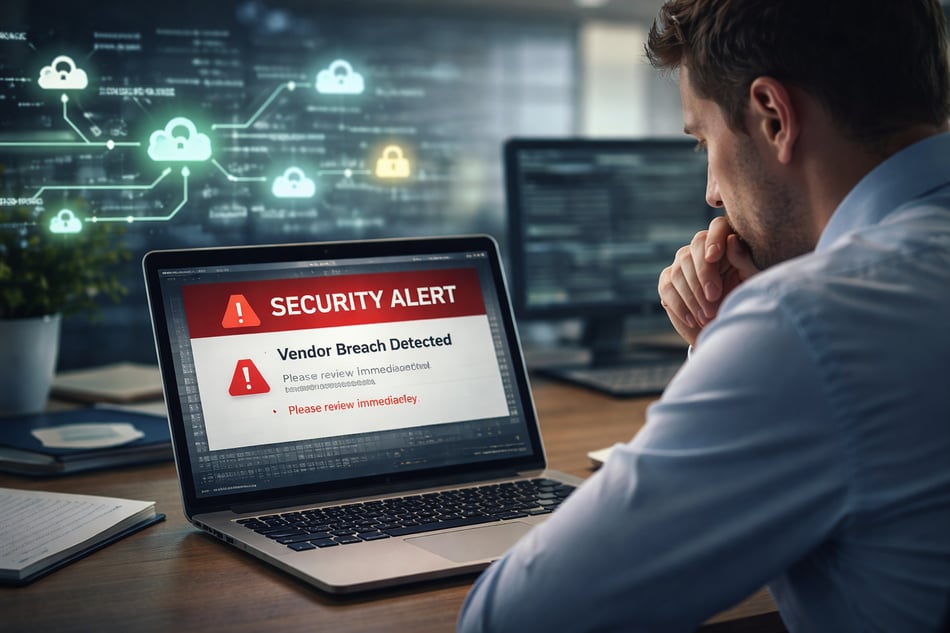
How supply chain attacks work and what you actually need to do when you get those emails
You get an email from a company you trust.
“Security incident detected.”
“Please review immediately.”
“Take action now.”
Your first reaction is usually one of two things. Panic or ignore it.
Neither one is the right move.
What’s Actually Happening
Most of these alerts do not tell you that your business was breached. They are telling you that something upstream was compromised.
A vendor you use relies on another vendor. That vendor relies on another tool. Somewhere in that chain, something went wrong.
That is called a supply chain attack.
It is not new. It is becoming more common. And it is confusing a lot of business owners.
Let’s simplify this.
You use an HR platform. That platform uses a third-party library of scripts, codes, and plugins. If that library gets compromised, your HR platform sends you an alert.
Nothing in your environment may have been touched, and your customer's information is still safe for the moment, but you still get the message that it was potentially at risk.
That is why these alerts feel vague and alarming at the same time. They are telling you there is potential risk, not confirmed damage. They are just performing due diligence so they don't get fined or sued.
Why You’re Seeing More of These
Two reasons. First, modern software is deeply interconnected. Very few platforms operate in isolation anymore.
Second, companies are under pressure to disclose potential risks quickly. So instead of waiting for confirmed impact, they notify you early.
That is a good thing. It just creates noise if you do not know how to interpret it.
The Real Problem: Misinterpretation
Most business leaders read these alerts the wrong way. They see: “Security issue” And translate it to: “We have been hacked.” That is not usually the case.
There is a difference between:
- A security incident
- A confirmed data breach
A security incident means something happened somewhere in the chain. A data breach means your data was actually accessed or taken. Those are not the same. And the actions you should take are different.
What You Should Actually Do
When you get one of these alerts, slow down and follow a simple process.
1. Do Not Click the Links Immediately
Even legitimate-looking alerts can be spoofed. Instead:
- Go directly to the vendor’s website
- Check their official status page or announcements
- Confirm the alert is real
This avoids a phishing attempt from becoming a real data breach.
2. Understand the Scope
Read the message carefully. You are looking for:
- Was your data affected
- Or is this a precautionary notice
Most alerts will clearly state something like: “We have no evidence that customer data was accessed.” That line matters.
If there was data affected, you may need to notify your customers, so talk to your IT department or MSP.
3. Take Targeted Action, Not Panic Action
If action is recommended, it is usually specific:
- Rotate passwords
- Reauthorize integrations
- Review connected applications
Do those things methodically. Do not start shutting systems down or making random changes. Talk to an IT pro about how to safely reset passwords and check your security and backups.
4. Review Your Own Integrations
This is the step most businesses skip. If the issue involves a third-party component, ask:
- What systems do we have connected
- What data flows between them
- Are those connections necessary
This is where risk actually lives.
5. Escalate When Needed
If anything is unclear or unsafe, this is where your IT partner steps in. You should not be interpreting these alerts alone. That's our job to be a professional resource for you.
When You Actually Need to Worry
There are times when these alerts are serious. You should escalate immediately if:
- The vendor confirms customer data was accessed
- You see unusual activity in your systems
- Credentials or access tokens may have been exposed
That is when incident response matters. Everything else is controlled risk management.
Not every alert is an emergency. But every alert is a signal. It tells you something about your environment, your vendors, and your level of visibility.
The goal is not to eliminate or ignore alerts. The goal is to understand them and respond appropriately.
Where Solve iT Comes In
This is where we take a lot of pressure off our clients. When these alerts come in, you get clarity instead of noise. That is the difference between reacting to IT and managing it.
If your team is unsure how to handle these alerts or is spending too much time reacting to them, that is a sign you need better visibility.
Book a free threat assessment with our team.
We will map out your environment, identify your exposure points, and give you a clear plan for handling situations like this with confidence.
No panic. Just control.