

When Multi-Factor Authentication Is Not Enough

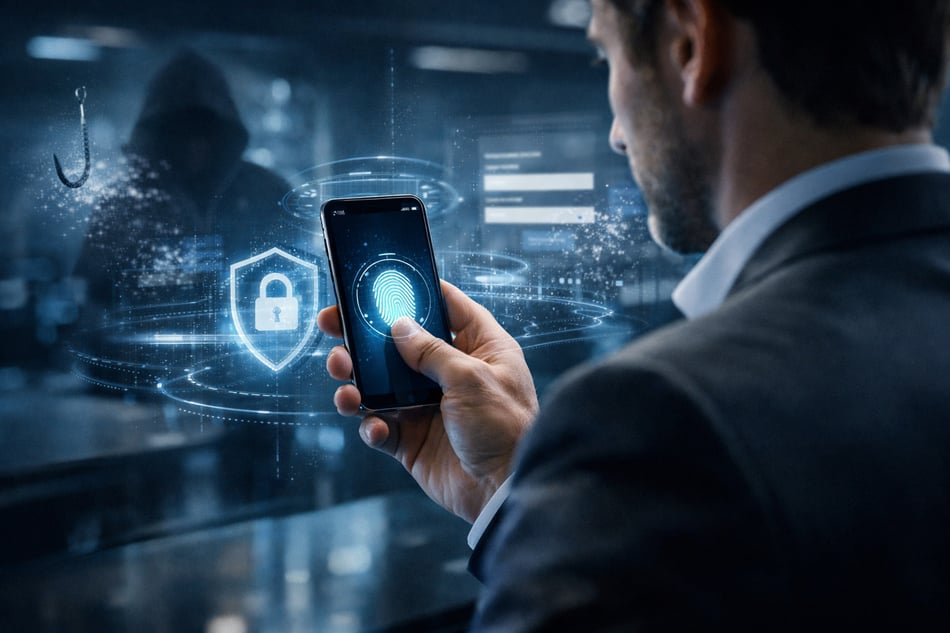
For years, businesses were told that enabling multi-factor authentication was the gold standard for account security. In many ways, it was a major improvement over passwords alone. Unfortunately, cybercriminals adapted faster than most businesses.
Today, attackers routinely bypass MFA using phishing kits, session hijacking, SIM swapping, push notification fatigue attacks, and stolen authentication tokens. We see it happen constantly across Microsoft 365 environments, cloud applications, banking platforms, and even cybersecurity vendors themselves.
That creates a hard truth for business owners and IT leaders...
2FA is still necessary; it just isn’t enough anymore.
At Solve iT, we spend a lot of time helping organizations reduce risk without making technology painful for employees. One of the most important security upgrades businesses should begin planning for now is the move from traditional MFA toward Passkeys.
Why Traditional MFA Is Becoming Vulnerable
Most businesses still use one of these multi-factor authentication methods:
- SMS text codes
- Authenticator app codes
- Push notifications
- Email verification codes
These methods are better than passwords alone, but they still rely on “shared secrets.” That means there is still something an attacker can steal, intercept, trick a user into entering, or replay.
Modern phishing attacks are shockingly convincing. Employees receive what appears to be a legitimate Microsoft login page. They enter their password and MFA code. Behind the scenes, the attacker immediately captures the session token and gains access anyway.
We have also seen “MFA fatigue” attacks where users get bombarded with approval requests until they finally click “Approve” just to make the notifications stop. It sounds ridiculous until it happens at 11:30 PM after a long workday.
Cybercriminals know people get tired. They build attacks around that fact.
What Makes Passkeys Different?
Passkeys eliminate the weakest part of authentication: the human entering secrets into websites.
Instead of relying on a password plus a code, Passkeys use public key cryptography tied directly to a trusted device. Your phone, laptop, or hardware security key confirms your identity locally using biometrics like Face ID, fingerprint, or device PIN.
The important part is this:
Your actual credential never gets transmitted to the website.
There is nothing useful for a phishing site to steal.
Even if an employee accidentally visits a fake login page, the Passkey simply will not authenticate because the cryptographic relationship only works with the legitimate site.
That changes the game entirely.
Many companies assume attackers only target large enterprises. That is simply no longer true.
Small and midsize businesses are often easier targets because they have fewer security layers, limited internal IT staff, and inconsistent identity management policies. Attackers know this.
At Solve iT, we strongly recommend organizations begin building toward passwordless authentication strategies now instead of waiting until cyber insurance carriers or compliance frameworks force the issue.
Passkeys help businesses:
- Reduce phishing risk
- Eliminate password reuse problems
- Improve login experience for users
- Lower helpdesk tickets tied to password resets
- Strengthen cyber insurance positioning
- Reduce account takeover incidents
This is particularly important for Microsoft 365 environments, remote workforces, financial systems, healthcare organizations, and companies with privileged administrative accounts.
Some business owners hear “Passkeys” and assume it is something meant for Apple users or personal Gmail accounts.
Microsoft, Google, Apple, Cisco, Amazon, and most major identity providers are aggressively moving toward passwordless authentication models. Enterprise platforms increasingly support Passkeys through standards developed by the FIDO Alliance.
This is where security is headed. That is because those companies have to be cutting-edge with their security, and now, so do you.
The companies that adapt early will have fewer breaches, fewer disruptions, and fewer sleepless nights after suspicious login alerts.
The Real Goal Is Reducing Human Error
Good cybersecurity is rarely about buying one magical tool.
It is about reducing opportunities for mistakes.
Employees are busy. Executives travel. Internal IT teams are overloaded. People click things they should not click. That reality will never fully change.
The best security systems account for human behavior instead of pretending humans operate like robots.
Passkeys are one of the first authentication technologies that meaningfully shifts security away from user memory and toward device-based trust.
That is a major step forward.
The Solve iT Security Recommendation
Traditional MFA still has value and absolutely should remain enabled. Turning it off would be like removing your front door because someone learned how to pick locks.
But businesses should understand that the threat landscape has evolved.
The future is passwordless authentication combined with layered security controls like device compliance, conditional access policies, endpoint detection, security awareness training, and continuous monitoring.
At Solve iT, we help businesses evaluate these risks every day through our Free Threat Assessment process. We identify weak authentication methods, exposed accounts, policy gaps, and areas where attackers are most likely to succeed.
If your organization still relies entirely on passwords and basic MFA, now is the time to start planning your next move before attackers make the decision for you.
Book your free threat assessment with Solve iT and let’s make sure your security strategy is built for where cyber threats are going, not where they were five years ago.